Sometimes our lives become loosely entwined with remarkable people, human beings who possess incredible talents, minds, ideas and actions. Often we fail to recognize how important they are to our lives. They bring a joy of artistry and spontaneity that our lives sorely need to be rich and fulfilling. And then, without warning, they are gone.
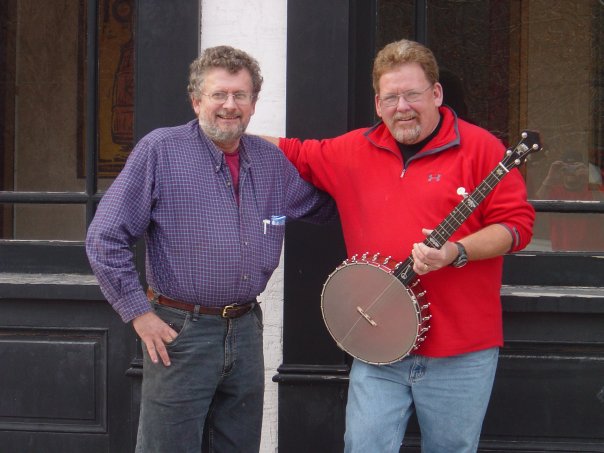
Mike Ramsey and I outside a biker bar in Northern Missouri
The first time I met Mike Ramsey, I had driven an hour into Kansas City to peruse the local banjo supply at Old Town Music, a long gone acoustic music store run by a great banjo player and his mother. For me, this was like a trip to the library where you could touch and feel all the old books that the world had to offer. Here was a jungle of open backed banjos from some of the world’s greatest masters. As I was demonstrating my limited tune knowledge on a variety of exquisitely designed instruments, I noticed a guy in a pair of overhauls and a flannel shirt with wildly curly hair watching me. He made me nervous, so I bleated out a weak, “Howdy,” to see if I could unnerve him.
To my dismay, he headed straight towards me. I knew he didn’t work in the store, so I was wondering what in the hell this guy wanted. “Say,” he said, “I noticed you were looking at a lot of banjos. Which ones here do you favor?” he asked.
I hesitated. What business was it of his? “Well if I had to say,” I cautiously replied, “I’m kind of partial to this Mike Ramsey ‘Woody’ model.”
“Right answer!” declared the stranger gleefully as he stuck his hand at me for me to shake, “I’m Mike Ramsey.” Damned. I was speechless. Standing right there with my banjo building hero and not a penny to my sorry ass. I wanted to buy that Woody 12″ cherry banjo right there, from the maker and live happily ever after. Well, in a way I did….
A couple years later, in 2007, having never saved enough to own a Mike Ramsey Woody banjo, I got up the nerve to attend one of his infamous banjo building workshops near Appomatox at the 4H Camp. It was Spring and quite cold as I can remember but the 8 or so of us locked away in the temporary woodshop Mike set up at the camp didn’t notice. These many years later, I refer to it in my memory as a weekend of guys, whiskey, power tools and eventually banjos. Mike was not only a master banjo builder, having built over 2000 banjos in his first 10 years in the business, but was an inspirational and remarkable teacher. In three days he helped each of us build, inlay, finish and play a quality banjo, largely from scratch and hardware. When each of us knew we had just ruined our project and took it to Mike with tears, he just laughed and said “The thing about wood is, it forgives you!” Taking our partially built instrument to the belt sander, fixing our wounded wood and sending us on our merry way.
After getting to know Mike at the banjo building fling, I decided I’d write an article about him for The Old Time Herald, a magazine that follows traditional musicians as well as luthiers like Mike. What I learned about him was pretty amazing. Born in 1949, Mike first heard old time music when he was in college, a business major at the University of Tennessee. Originally from Roanoke, Mike had heard the music of the mountains most of his life, but never really listened until a moment in college when he walked into a jam with his guitar that he happened to pass at an old church in Knoxville. Inside were two fiddlers and two banjo players who showed him the chords to “Liberty” and off he went. “I was mesmerized,” Mike told me. Soon he was traveling to Old Time Music Festivals across the South soaking up some of the great players of the time. “It changed who I was, forever,” said Mike.
After college, Mike went to work in the corporate world as a manager for Proctor and Gamble. He soon realized he wasn’t cut out for supervising hundreds of people and towing the corporate line. “They just couldn’t stuff me into that jar,” Mike told me. In 1983, Mike started a small hardwood lumber business in Ohio, learning about wood just as he was learning about old time music. He took banjo lessons and in 1986, won his first banjo contest. That same year, with the help and encouragement of friends, he built his first banjo. When he held it in his hands, his life changed once again. Having ordered a banjo from Kyle Creed the legendary builder from Galax, Mike was so disappointed when he found out Creed had died before finishing his banjo that he set out on his own quest: to build the perfect banjo. The one that Kyle would have built.
Soon, banjo making consumed much of his spare time and began to eat into his business time. In 1992 he met banjo builder Bart Reiter who became a tremendous supporter of Mike’s advising him about his work and helping him set up a production shop. In 1995, in Appomattox, his banjo shop was complete and his business Chanterelle Banjos was born. Mike started off by putting a beautiful rendition of the planet Saturn in the h eadstocks of his banjos and built them to sound deep and throaty like Kyle Creed. Before long, he was building banjos at a record pace and his banjos were featured in high end music shops from New York to Portland, Oregon.
Mike was an innovator in many ways. One was the speed at which he could produce a quality, hand crafted banjo. At one point he was able to produce a banjo a day, unheard of by most small builders. Another of his great innovations was the banjo head or skin itself. Mike, like many builders, was always searching for that authentic sound, that mysterious Kyle Creed plunk. He like other builders experimented with a variety of drum heads and skins to get the right sound. In the early 2000’s he was approached by a company that made timpani drum heads who was experimenting with a new synthetic head they called Fiberskyn, because of its resemblance in sound to skin heads without the hassle of using real skins which took great care and skill to fit and maintain. Mike loved the idea and was one of the first banjo builders to use the fiber heads, which have now become standard among open back banjo builders.
Mike was also known as a character. He liked whiskey, Volkswagens, cooking and collecting guns among other things. He was kind and generous, fun loving and an endearing friend. He was also wild as hell.
About a year after my story about Mike appeared in The Old Time Herald, I was at my home in Lawrence, KS when the phone rang early on a Saturday morning. It was Mike. “What are you doing right now?” he asked.
“Thinking about breakfast,” I answered honestly.
“I need you to come get me at the airport,” he said totally out of the blue. “I’m at the Kansas City Airport. We have a mission. I tried to explain to my wife why I had to spend the day driving to Kansas City to go on a mission with a banjo builder I barely knew, but she finally just shrugged and waved me away. I picked Mike up in my pickup and he handed me a banjo case to put in the back of the truck. Other than the banjo, his only luggage was a backpack.
“What’s up?” I nearly begged, wondering what I had gotten myself into. Mike jumped into the truck, throwing his backpack in the back and pulled out a wad of papers from his front pocket. “Your mission is to find this place,” he handed me a piece of paper that had some Northern Missouri address in a rural town I’d never heard of.
OK, I said trying to decipher his MapQuest printed directions. “I bought me a VW Bug on Ebay, he told me,” and you’re going to help me find it. After a couple of hours driving we pulled into a strange farm with a small house but two huge barns. A tall slender fellow with a cowboy hat met us in the drive. He brought us into the house and filled two huge bowls with some of the best and hottest chili I had ever tasted. Turns out he was an international Chili competition winner and was preparing for the Tulsa, OK chili cook off. Go figure.
We headed out to the first barn and the fellow raised the door to reveal several VW’s in varying states of disrepair. Except one. We had discovered a Missouri anomaly – a VW ranch. Mike got in the small black bug, shoved some cash at the guy through the window and yelled, “Follow me!” as he left in a haze of dust. I followed him out of the drive and onto a road, knowing full well that Mike had no idea where he was or where he was going. It was clear, however, that he was looking for something. And then he found it. In the middle of nowhere Northern Missouri, Mike had somehow led us to a biker bar.
He came over to the truck and took out his backpack which seemed to only contain a fiddle case. He handed me the banjo in the case and smiled, saying “Let’s go have some fun. Bikers love old time music!” I wasn’t so sure.
Once inside the bar, Mike was holding court. Teasing the young waitress, telling jokes to bikers and consuming copious amounts of alcohol. Soon, he handed me the banjo case and said “Here.” I opened the case to find a brand new Mike Ramsey 12″ Woody with a beautiful inlay in the scoop that was a “peace banjo” identical to the one I have tattooed on my right knee. I tuned the banjo up and we proceeded to play the day away in that bar. Finally, at about 6pm, Mike leaned over to me and in a fog whispered “Time to go.” I figured he’d finally had enough. As we got out to the parking lot, he asked “How’d you like your new banjo?” I couldn’t believe it, he had remembered that day in the store. I finally owned a real Woody. I pleaded with Mike to to home with me and rest up before he drove back to North Carolina where he was living. “Gotta go!” he proclaimed, and drove out of my life, only to be seen as a glimpse at a festival or concert here or there.
Mike Ramsey was a wild genius. He was an innovator, a master craftsman and a lover of humans. He had his flaws, as we all do. He made some mad, but many more happy. He made the world he lived in a better place because of the joy he got from hearing people play his banjos. He is survived by two beautiful and incredible daughters Sarah Rovnak and Racheal Kerns and by his sister Gayle Brown and his brother, Kevin Ramsey. He is also survived by a world wide community of old time musicians who often tell stories about him around campfires high in the mountains late at night, or play dance music on plunky banjos early in the morning. His thousands of banjos live on!
In the very early morning of August 11, 1933, Albert Hash and his three brothers got their morning chores done early. The excitement they felt must have been contagious as they ran up and down the mountains and hollows of the highlands of Virginia, travelling by foot from their remote three-room home in Fees Branch to the very top of the second highest mountain in Virginia. Albert was just 16 and had already built his fourth fiddle. He had carefully placed it inside a gunny sack that morning to prevent his neighbors from judging his fiddling ways. After that day, the Third Annual White Top Interstate Folk Festival, he would never hide his fiddling or his fiddle playing again (Smith, 8-10).
As the three young men approached the mountain top, after nearly four hours of hiking, they very likely gasped in unison at what they saw. Spread out across the rounded peak and sides of the mountain were nearly 22,000 people; more than the population of the entire county, more people, cars, horse carts, tents, and musicians than they had ever seen in their lives. These folks, including the First Lady of the United States, Eleanor Roosevelt, had made the perilous back road journey up the mountain for one unified purpose: to hear the music and see the local dances of the Appalachian Mountains as pure as possible, in their “native” environment, and to listen, dance, and shout themselves with the intensity of feelings the music elicited from them.
For nine years, 1931-1939, the White Top Mountain Festival became a national celebration of the music and culture of the Southern highlands, launching the early careers of many young traditional musicians like Albert Hash, and solidifying the careers of many other more well-known musicians attending and competing. Some would become legends of old-time music like Fields and Wade Ward of the Galax, Virginia, band The Bogtrotters; Frank and Ed Blevins of The Tar Heel Rattler’s fame; Hobart Smith and his sister, Texas Gladden, and Emmet Lundy. Others would find new joy in trading regional tunes and playing together long into the night.
Listen to Albert Hash fiddle “My White Top Mountain Home”
It would not be hard to assume that in a region that is considered the birthplace of all country music, that is considered the font of old-time fiddle music and mountain ballads, that such a famous series of gatherings would be continually celebrated and chronicled in the academic literature of folk music in America. Alas, it is not. White Top’s fame, notoriety, and any celebratory or positive research of its impact on the music of the southern mountains have been quashed long ago. Its status as the “whipping post” of the cultural elite became solidified with the publication, in 1983, of one book: David Whisnant’s All That Is Native and Fine (Chap. 3).
Whisnant, an English professor who had grown up near Ashville, North Carolina, and then left the mountains for many years only to return with a big-city education and an attitude about what was best, native, and fine, quickly climbed to the top of the mountain in the new burgeoning field of Appalachian Studies. His academic pontification purported that the White Top Mountain Festival was one of three cases (the only three he has ever given us) of what he termed “systemic cultural intervention.”
Whisnant defined these interventions as occurring when “someone (or some institution) consciously and programmatically takes action within a culture with an intent of affecting it in some specific way that the intervenor thinks desirable.” He goes on to specify that these interventions, whether “active” or “passive,” can have unintended or intended positive or negative effects upon the receiving culture (pg. 13-14). He also believed, based on three case studies, that the results were almost certainly damning to any culture.
The three cases that Whisnant chose to illustrate are interestingly and notably led by women. They include, aside from his biting rebuke of the White Top Mountain festivals of the 1930s, the efficacy as cultural interventions of the Hindman Settlement School in Kentucky founded in 1904, and the development of the John C. Campbell Folk School in Brasstown, North Carolina, in 1926. It should be noted that the women who were spearheading each of these three movements deeply believed in one unifying purpose: that mountain culture was well worth saving, sharing, and celebrating (Mathews and Kirby).
In the case of the White Top Festivals, Whisnant blamed the naivete of folk song collector and festival founder Annabel Morris Buchanan on allowing the intervention to become what Whisnant calls “manipulation of reality” (p. 247). Along with composer, scholar, tune collector, and pianist extraordinaire, John Powell, an admitted fan of Anglo-Saxon music over other forms, and lawyer and entrepreneur John Blakemore (who happened to own the top of White Top Mountain), Buchanan became intrigued with the idea of creating a large venue to showcase the music she deeply loved, the music of the mountains.
White Top was certainly not the first folk festival to showcase the music of the Appalachians. Entrepreneur and salesman Bascom Lamar Lunsford had already successfully developed and was evolving the annual Mountain Dance and Music Festival in Asheville, and Jean Thomas was successfully hosting the American Folk Song Festival to promote Kentucky mountain music. They were soon followed by the establishment of The National Folk Festival, organized by Sarah Gertrude Knott. Even Whisnant found that these four monumental festivals shared a noble premise, to “bring the performers out of their isolated surroundings and place them before an appreciative audience.” He went on to surmise, “That approval would heighten the performers’ sense of self-worth and pride in their imperiled culture” (Native and Fine, p. 185).
Although similar in nature and structure, Whisnant never attacked the other three major Folk Festivals of the ‘20s and ‘30s. In fact, in a 1979 piece published in the Appalachian Journal, he spent nearly 20 pages heaping praise upon Lunsford’s Mountain Music and Dance Festival upon which the White Top Festival had been partially based (Mountain Music and Dance). What did Whisnant see that separated White Top from these other major “systemic cultural interventions? Why has one fallen into the cracks of historical significance while the other three continue to be lauded in academic and popular history? Why did Whisnant brilliantly decimate the reputation of White Top?
Whisnant castigates the White Top organizers for being too focused on the virtues of Anglo mountain music and its purity and superiority as representing a fragile culture (Native and Fine). On the other hand, he depicts Lunsford’s noble cause as “to seek at last a position of parity for the fiddler by the opera door, and to thereby inject a note of cultural realism and authenticity into the imported booster fantasy” (Music and Dance, 138). One elevates the fiddler above opera, the other, White Top, hopes to elevate the fiddler to be considered playing a valid and vibrant music that could add much to the compositions of classical and operatic programs. Were not both noble grounds upon which to build festival premises?
Whisnant’s criticisms have not been without detractors. However, for the most part and for unknown reasons, his 1983 book has rarely been challenged by academics and most of the criticism has come from non-academics. In a rare rebuke, researcher Helen Lewis and musician and musicologist Rich Kirby saw the book as “marred by its contentiousness and tendency to overdramatize (p. 654). Few others have been so bold.
One of Whisnant’s primary complaints about White Top was the not-so-hidden proclivities of its founders, John Powell, towards racism. This is certainly a valid criticism, especially coupled with the fact that during its nine years, the White Top festival directors did not allow Black musicians to play from the stage or compete in the contests. However, remember that this festival, like Lunsford’s, took place in the deep South in 1930’s America and had grown out of the smaller fiddler contest movement that had been happening in the South since the 1700s.
To this day, with hundreds of old-time and bluegrass music festivals and contests being held across the nation, it is rare to see black participants and performers at these festivals. In 2019, for example, The National Appalachian String Band Festival, held for the past 30 years in Clifftop, West Virginia, with nearly 3,000 participants from across the world, had its first Black winner in any of the numerous categories of competitions offered during the week-long festival. It is both by musical heritage, constituency, and subtle bigotry that this trend has continued.
However, Whisnant’s complaint could be leveled against the board of nearly every major fiddle contest in the country, from the Galax Festival to MerleFest, to both be predominantly white and to promote primarily Anglo music over other more integrated musical genres. There are and always have been representations of many cultures in what we know as “traditional” American folk music of the South, but for whatever reasons, they have remained, until more recently, primarily segregated by venue and festival type. This is, was, and will be an ongoing challenge to folk music organizers, but certainly wasn’t unique to the White Top founders.
It is also a fact that currently, according to music journalist Jemayel Khawaja writing in The Guardian in 2017, that all American music festivals remain largely controlled by and attended by primarily white participants. One of the iconic current music festivals, Burning Man, has an 87% white attendance. Coachella, another iconic nationally attended music festival, has under 5% black attendees. Khawaja finds that nearly all American music festivals have been less than friendly to black participants over their long history. The problem, according to Khawaja, is that festival organizers, promoters, and sponsors are Caucasian.
It should also be noted that Lunsford biographer, Loyal Jones, could find no instance of Blacks ever performing at one of the Mountain Music and Dance Festivals. While Lunsford certainly had no political agenda such as John Powell in excluding Black performers, it is obvious that he did not see them as the right “fit” for his festival. Thus, it should be noted that White Top did not and does not stand out as a particularly racist construct among the distant and recent history of American festivals.
While Whisnant not only chides the organizers of White Top for excluding Blacks, he also blames one of the organizers, John Blakemore, for having more entrepreneurial interests than merely promoting the music of the mountains. That criticism is a bit suspect following the praise that Whisnant had previously given Mr. Lunsford, who was, like Blakemore, both a lawyer and an entrepreneur who had previously made his living as an “authentic” mountain musician even though he had also been educated at two colleges and an academy, been to law school, taught English and history at Rutherford College, edited newspapers, and worked as a federal agent (Mountain Music and Dance, 140).
In many ways, it seems, Lunsford’s forays into promoting mountain music were for monetary concerns as well as ideological undertakings. Reportedly, he was often viewed as “shiftless” by local musicians. Even by Whisnant’s measure, he was a ruthless self-promoter who loved to see his picture on handbills, and often referred to himself as “the minstrel of the Appalachians.” In contrast, none of the White Top organizers tried to further their own reputations through the festivals, but stuck to their ideological, financial, and more humble interests in promoting mountain music. While Blakemore owned the festival grounds, he generously spent hundreds of dollars on improving the festival site to accommodate the large numbers of performers, attendees, and dignitaries who made the trek to the mountaintop over the years.
Another problem with Whisnant’s critique of White Top compared to his adulation for the Mountain Music and Dance Festival was his distaste of Buchanan and Powell’s requirement that White Top performers adhere to the rule that “Only old time music [will be] considered in contests: no modern songs, tunes or dances” (Native and Fine, 229). On the other hand, Lunsford dictated to his performers that they not wear cowboy or hillbilly garb and often guided their choice of music to play on stage. Again, the organizers of fiddle festivals from the 1740s to the present day have been very clear in dictating what type of music can and can’t be played, but few, if any, have actually told the performers how to dress.
One of the current longest running fiddler conventions in the U.S., The Old Fiddler’s Convention at Galax, VA., has more than 27 rules performers must adhere to, including type of song, length, format, composition of musical personnel, style of playing, and much more (Galax Rules). Contests and festivals have always tried to limit their performers to certain genres , similar to both Lunsford’s festival and the White Top Festivals. Whisnant’s contention that Buchanan and Powell’s demands that performers not play “modern” tunes and limit themselves to “archaic fiddle and banjo tunes with Child ballads” does not seem particularly limiting if you consider that the purpose of the event, like Lunsford’s and others’, was to promote music that was indigenous, not modern or “hillbilly” music that was quickly overshadowing through radio and mass distribution of recordings the folk music of the Appalachians.
While Whisnant took great afront at the fact that many performers went back to their homes and sought to find more “authentic” tunes and songs to perform at the festival, this appeared to be one of the legs of any folk process, to seek out tunes from older times, to learn them as close to the source, either written or by hearing them in person, and then presenting them to a wider audience. What Whisnant found appalling seems to be the process of every folk musician in America, although now “authentic” renditions are often learned off the internet from such sources as Slippery-hill.com. In many ways the White Top organizers may have helped save many mountain tunes from extinction by their insistence on non-modernized tunes and their ban on “hillbilly” hits.
The areas of extreme praise that Whisnant heaps on what he seems to believe is a positive systemic cultural intervention, The Mountain Music and Dance Festivals, are the positive impacts upon the performers, upon the traditional culture of the region, upon other festivals, and upon the popular image of mountain culture itself. If these are the standards upon which one judges the relative success of a “systemic cultural intervention,” then one must examine the neglected constituents in the entirety of All that is Native and Fine; we must consider the impact upon the participants themselves. As Mathews and Kirby put it, Whisnant’s critique has a “curious lack of testimony from the ‘other side,’ from the people whose culture was being interfered with” (p. 653).
In the case of the White Top festival, Whisnant did manage to interview one participant, Albert Hash, even though many of the hundreds of performers who had participated and many local people who attended were still living when Whisnant went to White Top to do his research.
Hash, a young fiddler of 14 who had already built several fiddles when he attended the first White Top Festival in 1931, saw the festival as a major turning point in his musical life. As recounted earlier, he had carried his fiddle in a gunny sack to the festival to hide it from the scornful eyes of neighbors who did not all approve of fiddle music because of longstanding religious beliefs in the primitive mountain churches. When young Hash was invited to help play for dancers at the festival, then was invited to play with one of his idols, Fries, VA., musician and balladeer Henry Whitter, and saw the accolades his fiddling drew, he never hid his fiddle again (Smith, Chap. 1).
Hash related to Whisnant, nearly 50 years following the festival, that a Colonel Kettlewell from England took a picture of his home-made fiddle. He realized for the first time in his life that his pursuit of music was taken much more seriously than he had considered and that for the first time, he felt “justified in what he was doing” (Native and Fine, 232). That is no small statement from a young man who would go on to build over 300 fiddles in his lifetime, play at the Smithsonian, Wolf Trap, The World’s Fair, and venues nationwide, teach fiddling and fiddle building at folk schools across the South, launch hundreds of luthiers, including Virginia guitar-building icon Wayne Henderson, and establish the first school-based program for young people in the U.S. dedicated to teaching young people the traditional music of Appalachia, now known as Junior Appalachian Musicians. When Hash died in 1982, the Virginia Legislature noted his life with a proclamation and a moment of silence. Hash often credited it all to that long trek up White Top Mountain (Smith).
Hash’s life alone stands as lasting tribute to the cultural value of the White Top festivals but Hash was not the only regional participant who was deeply affected by the festivals. Among those who benefited were many names that have become legendary among folk enthusiasts:
Frank and EDD Blevins with Mrs Roosevelt at Whitetop
Frank and Edd Blevins: These two brothers had already recorded as members of the Tar Heel Rattlers and had ended their careers to work at a furniture factory in Marion, VA. Specifically, for White Top, and at the urging of Mrs. Buchanan, they formed a new band with banjoist Jack Reedy and became the Southern Buccaneers, reviving their careers and winning many prizes at the festival. During this time, they became the foremost country string band in Southwest Virginia, with a diverse local repertoire and frequent broadcasts over radio stations across the area. They often attributed the tutelage of White Top founder Annabel Morris Buchanan for their continued success. In 1933, Eleanor Roosevelt herself pinned two blue ribbons on Frank, whose recordings would later be considered among the finest examples of early southern music ever recorded. Their influence on the music of the area continued until 1944 when Ed tragically died, and Frank hung up his fiddle.
Wade, Crockett and Fields Ward, Eck Dunford, and Doc Davis: The Bogtrotters: Legendary banjoist Wade Ward, from Independence, VA., his brother, Fields Ward, and his brother’s son, Fields Ward, had formed a group that premiered at the White Top festivals. Known as the Bogtrotters, they were to become one of the most enduring string bands in American history. Although the original group lasted until the 1950s, a newer version of the band continues to play many of their original tunes in Southwest Virginia today. Wade’s banjo playing earned the attention of Folklorists John and Alan Lomax, who recorded several sides with him and the Bogtrotters following one of their trips to White Top. Their unique style of string band music captured the attention of a worldwide audience and served as a foundation for the formation of the Galax Fiddler’s convention where they became known as the house band. In the 1950s, folklorist and performer Mike Seeger rediscovered Ward’s recordings and helped issue several sets of recordings that have carried his reputation as one of the greatest of all old-time banjoists into the current era. (Carlin)
Art Wooten
Arthur Wooten: Wooten had grown up and always lived in rural Alleghany County, NC, and came to White Top festivals as a young fiddler at the beginning of his career. He often performed with a contraption he built that allowed him to play the guitar and organ at the same time. His fiddling was noted by many during his performances at White Top and that directly led him to be hired by Bluegrass Master Bill Monroe and in 1939 to become the first fiddler in Monroe’s band. Following that he became a beloved member of the Stanley Brother’s Clinch Mountain Band and helped them define their classic Bluegrass sound. (Blueridgeheritage.com)
Harold Hensley: Hensley was a shy teenager when he took the stage at the 1938 White Top festival. Born on the mountain, this was his first real public exposure. In the 1940s he headed to California armed with a fiddle built for him by neighbor and fellow fiddler Albert Hash. Hensley would go on to have a nearly 40-year career as a fiddler, actor, and showman. In 1943, he was the featured act on WSM’s Grand Ole Opry. He also was a regular on WHO’s Iowa Barn Dance Frolic, and the Hometown Jamboree. He appeared infrequently on the popular TV show the Walton’s as a fiddler, and was inducted into the Western Swing Society Hall of Fame. He also penned many songs, including “You’ll find Her Name Written There” that was recorded by Bill Monroe and the Bluegrass Boys.
Roy “Speedy” Tolliver: Roy Tolliver, like his lifelong friend, Harold Hensley, who he met in a jam session at a White Top festival, became inspired at the White Top festivals to pursue a life in music. He had walked to the festivals from his house, banjo in hand. JWhen he was well received in the banjo contest, his life took a turn and he decided to be a professional musician. In 1939 he moved to Fairfax, VA., to play in a band with John Stringer, a powerful young fiddler he had first met at a White Top festival. For five years they played in the Washington, DC, area as the Melody Trail Boys, sharing old time mountain music with an urban crowd. In the ‘40s the two formed a new band known as the Lee Highway Boys that quickly became a favorite of the transplanted Appalachians who had moved to the city to find work. Later he played with legendary bands such as The Stoneman’s and in Roy Clark’s (of Hee Haw television fame) band. During his career he performed at the Kennedy Center and the Smithsonian, toured Europe with a show organized by folklorist Joe Wilson, and played for President Jimmy Carter at the Whitehouse. He received the Virginia Heritage Award and a Speedy Tolliver Fiddle and Banjo Contest is held each year in Arlington, VA. (Spencer).
In fact, most, like William “Uncle Bud” Spencer, saw the “systemic cultural intervention” as one of the highlights of their lives. Spencer, who lived right below the mountain, won the traditional dancing competition in 1933. When the First Lady of the United States herself pinned the two blue ribbons he won on his chest in front of a roaring crowd, he vowed to always remember that moment. Spencer, who became the grandfather to world renowned fiddler Thornton Spencer of the famed traditional string band The White Top Mountain Band, stayed true to his word. When he died, he requested that those two ribbons, still carefully pinned to the vest he danced in at the festival, be placed on his corpse.
These are just a few of the stories of the powerful cultural influence that the White Top Mountain Interstate Folk Festivals had on its participants, stories that Whisnant either denied or failed to investigate. Nearly all of the folks mentioned were still living in the White Top area when Whisnant interviewed Albert Hash. However, they were not alone. It is highly suggested that links to the cultural influence of White Top be investigated for Hobart Smith and his sister Texas Gladden, Horton Baker, Emmet Lundy, John Cruise and family, O.C. Roark, C.B. Wholford, Francis Atkins, Jake Rosenbaum and members of The Peakes Band, The Moonlight Ramblers, The White Top Jiggers, The Old Virginia Band, and countless others.
In summation, the validity and worth of a systemic cultural intervention cannot be judged solely on the proclivities of the founders of an event. It must be measured against the worth it had in the culture itself, by the people who live in that culture. To simply surmise that because the founders of an intervention are elites or have archaic views does not mean their contribution is worthless. If that were the case, then Whisnant’s beloved Mountain and Music and Dance Festivals would surely be admonished for being run by a huckster and elitist who pawned himself off as “the balladeer of the Appalachians.” In order to determine the value of any cultural intervention, one must examine the lives and voices of the people of the culture and in the culture.
In August of 2019, a group of 50 local musicians gathered on top of White Top Mountain to celebrate the history of the White Top Festivals. They spent a day eating barbeque and playing the archaic tunes that were loved by the founders of the festival. Even though the remnants of lodges and tents that once proudly adorned the mountain are gone, the participants found joy, strength, and confidence in the music of their ancestors. Among the musicians were direct descendants of White Top’s influence, including guitarist and guitar builder Wayne Henderson. It is hoped to be an annual event for many years to come. Like the Festival itself, it had a humble resurgence. Let us hope this revival will not be judged as harshly as its predecessor.
Listen to the beautifully mysterious “Twin Sisters” played on Fiddle and Banjo by Sidna and Fulton Myers
Sidna Myers as photographed by John Cohen in 1965
When I heard the tune named Twin Sisters (listen above)by Sidna and Fulton Myers,I knew I had to learn it. It had everything. A title that made you wonder, a modal sounding-deep in the mountains-feel, and my favorite setting, just fiddle and banjo. Old style. The way of the Holler.
Not only did I want to play it, I wanted to know everything about it. Where did it come from? Who were these musicians What did it mean? In other words, as I often do, I became obsessed.
It turns out that my search would lead me first to Ithaca, New York, to Long Island, and Manhattan then down to Pennsylvania and Massachusetts, and ultimately, to 11 miles from here in the holler to Five Forks, Carroll County, and to graveyards across SW Virginia. This journey had some strange and fun hairpin turns, major potholes and dead end roads along the way.
Sidna and Fulton Myers lived in a very rural area, just a few miles north of Hillsville, VA. in a village known as Five Forks. Although not remarkably rugged the pastures of the area sit comfortably at about one half mile above sea level. According to locals, the Myers brothers were born and lived, as far as is known, in Five Forks all of their lives. Sidna Monteville Myers was born on September 25, 1890 and died December 18, of 1972. His younger brother James Fulton Myers, came along four years later, on April 22 of 1894 and died on January 3 of 1979. That much we do know for pretty much sure. Facts beyond that are more than a bit fuzzy.
Sidna and Fulton resided in a Virginia world, that was much different than mine. Neither of the brothers ever had electricity or running water on their farms. Crop and livestock work was hard, involving battling rocky soil and a host of predators, and, at times we know at least Fulton went to work on and off in the furniture mills of Galax. The neighbors lovingly remember the brothers, from the time they were young men, playing tunes together on into the night on one or the other’s back porches.
Over time they learned a local SW Virginia repertoire that included tunes in the style of both Galax and nearby Round Peak, and we know that they traded tunes with the likes of Tommy Jarrell as well as the Ward and Crockett families. That was later. When you really listen, though, what comes through is the Myers brothers, playing their hearts out in a smooth, mystifying old time style that was shaped by the Blue Ridge life they lived. If you listen, you can hear the meanness of their work, the beauty of their surroundings, the tragedies of their lives and the echoes of those who had gone before them.
“Now they were old fashioned,” fiddler Wayne Lowe once told folklorist Kevin Donleavy, with his wife, Edna chiming in, “They stayed the old time way.”
Fulton Myers
Wayne also recalled that Sidna often wore the old time button up shoes from early in the past century but as to the music the brothers played, he was exuberant.
“They played the smoothest music I believe I ever heard,” he recalled. “That music was like floating on water!” Thus begins the mystery of the Myers brothers.
Sometime in the summer of 1962, a 22 year old geology student at the University of Pittsburg, Peter Hoover, loaded a banjo and some sophisticated, borrowed recording equipment into the back of his parents car and headed for the South.
It was Peter’s second trip to the area around Carroll and Grayson counties in Virginia in search of real, authentic banjo music. On his first trip he had met such local luminary musicians as Wade Ward and Glen Smith (Smith is another mysterious figure in local circles, a great banjo player who won many contests and appears in several collections of music including Peter Hoover’s, he was from the same area, as was another musician by the same name who later moved to West Virginia and claimed fame there, very confusing, but its history!)
Anyway, Smith had told Peter that he had to hear and record the Myers brothers and told him how to find them. When Peter got there, he realized that the first problem was that he had absolutely no where near to plug in his humongous tape recorder. Patiently, he pleaded with Sidna and Fulton to help him find some place to plug in so that he could record them. When they played their smooth, powerful tunes there on the porch he nearly demanded them to help him.
Listen to Sidna and Fulton play “Shady Grove” in a unique modal setting, unlike many of the other versions
Spraker’s Store Five Forks, VA
So, Peter, the Myers brothers, and a few tag alongs headed up to Spraker’s General Store, a modest little country store that had the only electricity in the area. There, on a summer day, Peter Hoover brought the spotlight of the infant folk music revival onto the music of two brothers who didn’t even own a record player between them. During the recordings, sometimes you can hear a small grandchild bump the recorder and slow it down. It was both reel to reel and real!
The Myers preferred to play in the oldest style of Virginia music. Banjo and fiddle. No guitar, no bass, nothing between the melodic whine of the fiddle and the ringing drum of the banjo. All of their music was learned by ear, by listening to others, or through the painful process of memory, hearing a tune and then trying later to scratch it out. This was the way it was in the mountains when the African Americans first brought the instrument to the South and the minstrel shows popularized it. This was how the settlers in the Blue Ridge, finding they could fashion a banjo out of wood and hide first played it. In perfect synchrony with the mesmerizing tunes of the fiddle, brought from many places around the globe and sifted through the rugged hills and hollers of the mountains. Listen to how the Myers set Shady Grove. It is Five Forks Shady Grove, for sure.
Fulton, who somehow garnered the nickname “Jimmy Natural,” played in a style of fiddle that as Charlie Faurot later said, “was pure rural music.” This was dance music, the dance music of 100 years ago, when the Myers were young men, and they played it well. The boys had been playing since they were 8 or 9 years old, learning first from their father and according to Kerry Blech, who wrote a review of the CD made from Peter Hoover’s tapes, from “Old Man” Mac Farmer who gave Fulton his first fiddle. It was during these early years that they first traveled a few miles to North Carolina to learn tunes from Tommy Jarrell and his Civil War era fiddler father, Ben Jarrell.
The recordings that Peter Hoover are luscious, rich reminders of Appalachia’s past played by people with a strong sense of passion about their place, their Blue Ridge Mountain homes. So impressive were they when the New York Folk elite heard them, they immediately had to travel South. Three years later, Sidna’s banjo plasying came to the attention of banjoist, film maker, folklorist and “Beat Generation” survivor, John Cohen. Cohen, who lived on Long Island, had decided, after hearing snippets of various recordings and having founded with Mike Seeger (Pete’s half brother) The New Lost City Ramblers, a folk-revival group playing old time music in New York City, he needed to go South.
So Cohen threw his smaller recorder, various instruments, a few clothes, into his Volkswagen Beetle and somehow convinced his wife, Penney to climb in with their five month old daughter, Sonya, and headed down to the Blue Ridge. John’s first stop was the home of Sidna Myers. There he recorded Sidna’s banjo artistry on two songs. The first was a solo banjo version of Twin Sisters (the haunting tune at the top of this page) and the second was “Alabama Girls” a tune that Sidna claims to have made up and chided Cohen to learn. These are both stunning examples of clawhammer artistry and Cohen, who was a banjo player was very impressed.
These recordings that Cohen made, would sit in his New York home for nearly 10 years. Besides Sidna, he went to the houses of Wade Ward in Galax, E.C. and Orna Ball in the Mouth of Wilson, and headed on over to North Carolina to record Frank Proffit, Doc Watson’s father-in-law, Gaither Carlton and a host of musicians and ballad singers. Then in 1974, Rounder Records, deep into 10 years of folk revival recordings, ask John to produce the collection. And produce he did, complete with stunning photos. The album did well over the years and was critically acclaimed and, in 1995, Rounder re-issued the collection on CD and added 30 more minutes of original recordings. Big stuff for a musicologist.
In 1968, another knock came on the Myers brother’s doors. This time it was a Yale educated Manhattanite named Charlie Faurot rented a house in Galax. Another banjo player, Faurot sought out the Myers brothers with another, even smaller recorder and recorded 10 unique and powerful tunes from the brothers. Two of these tunes made it to later releases by. Faurot and County Records owner Dave Freeman, both the famed Clawhammer Banjo Volumes in 2004, and the Legends of Old Time Music Box Set in 2015.. I think its important to note that at this point, the brothers had not (nor ever did) garner one cent for all this recording work. They both seemed to love that these young folks with fancy electric machines wanted to record them and neither encouraged or discouraged them. In true rural fashion, they just played the tunes they had to play.
The Myers Brothers
In the coming years, many others would trek to Five Forks and record them. The last known field recordings were made by Blanton Owen, who had a session in 1973 recording Fulton, a year after Sidna died. These tracks were later released on a very successful but controversial set called “The Old Originals” on Rounder. Controversial because esteemed White Top Mountain fiddler Albert Hash felt that Owen and his recording partner had not really let the musicians know that these recordings were going to be published by a big industry firm and that they used “rough sounding” takes that didn’t really represent the skill of the mountain musicians who were featured.
In 2005, the Field Recorder’s Collective, a group of old time music collectors led by another New Yorker, Ray Alden who was a teacher who frequently made his own trips to the area, released 25 tunes that Peter Hoover had recorded on their own label, simply known as FRC504-Sidna and Fulton Myers.
So, at least three prominent musicologists, two funded folklorists, and five separate releases of the Myers recordings had been out in the public since the early 70’s to 2015, being issued and reissued. In old time folk music, that is notoriety! But here’s my question. All of these young visitors, all of these years of listening by banjo and fiddle addicts and this article contains the sum total of what we know about these very talented and well recorded brothers.
My search, so far, has turned up a few neighbors, quite a few locals who play their tunes especially a beautiful quirky dance tune called “Sweet Grapes,’ but no one seems to know a thing more about them. Especially Sidna. Blanton Owen wrote the few things we know about Fulton, but no one seemed to say much about Sidna, except that he “always had a chaw.”
In this hero worshipping culture of ours we seem to know every detail about our musical performers. Who they sleep with, what they eat, where they shop, and so on. Well, here’s the kicker. I decided to hunt down the long gone brothers and say a few words of gratitude to them both. I travelled first, of course to Five Forks to look for Cemeteries. I found one. Just a few feet from Spraker’s store where Peter Hoover first recorded them. The Shiloh Methodist Cemetery. I got out on a windy spring day and walked the small plot. No luck. I succumbed, I googled. No “Find a Grave” listing for a Sidna Myers or Fulton Myers.
However, there did appear to be a Myers Cemetery just up the road. I found a beautifully maintained cemetery with many folks named Myers and Sutphin and Spencer and other local names but no Fulton or Sidna. Over the course of the next week, I examined every cemetery within 10 miles of Five Forks. Nothing. Then I got desperate. I Facebooked a Carroll Count Virginia Facebook page. Immediate feedback. Thanks to some kind folks who knew the area, I found both of them the next day.
Sidna’s grave. Notice the spelling of Myers!
Sidna, it seems was at Five Forks in the Shiloh Cemetery. There were two reasons I didn’t find him. One the large gravestone in the very northeast corner of the cemetery had his name spelled wrong. I verified it from his death certificate that was spelled right. Sidna, it seems, will live in infamy as “Sidney M-E-Y-E-R-S,” not Myers. Hours of recordings, scores of musicians learning and loving his banjo playing, half of New York City coming to visit and they couldn’t even get his name right. Why?
Fulton Myers and Claude Felts
Oh, and guess what? Fulton is buried nearly 15 miles away up above Piper’s Gap at the Coleman Primitive Baptist Cemetery. After nearly an hour of searching the 30 or so graves in this beautiful mountaintop resting place, I found him. If you look at the tombstone, however, you’ll notice that he is buried not with his wife or family, but with someone named Claude Felts, who passed in 1971. Well, at least they got his name right.
I can see Edith Lowe smiling when she told folklorist Kevin Donleavy about the brothers:
“You could go up to their house some evening. They’d say, ‘We don’t play anymore.’ Then, they would get their instruments out and they wouldn’t have to tune them. So you would know by that they were playing all the time.”
They played it alright. And they were heard. But like so many before them, their haunting melodies and beautiful fingerings are outliving even the slightest memories of them. I can hear the wind at Five Forks and up on Coleman Mountain wondering, “Sidna and Fulton, where did you come from? Where’d you go?” It’s the mystery we live with.
Bibliography
County Records, 6001, Legends of Old Time Music Liner Notes by Kinney Rorrer
Field Recorders Collective, FRC 504, Sidna and Fulton Myers, Liner Notes
Kerry Blech, Review of Sidna and Fulton Myers FRC 504 originally from The Old Time Herald, available here
Kevin Donleavy, Strings of Life, 2004, Blacksburg, VA Pocahontas Press
I come from Kansas. Even though I lived and often worked on Kansas farms and have been around lots of livestock, I had never, not once, eaten, fed, smelled, thought about or even really looked at a goat. Having too much time on your hands in retirement can cause you to think strange thoughts and travel through unusual portals.
One beautiful spring day, standing on the porch of my cabin, I turned to my dear friend, Nancy, and said, “I’ve been thinking,” (she knew this was not always a good thing) “I’d like to clear that little fenced off two acres over there, and I think we need some goats to do it.” Nancy just shook her head.
I had been reading and watching videos about a strange breed of goats called Tennessee Fainting Goats.” All I knew about them is that they are actually a recognized breed because of a carnival barker from Tennessee.
It seems that in the early part of the last century this sideshow guy had a goat that would faint every time it was startled. Some genetic quirk caused the goat, upon hearing a noise or being threatened, to put its front legs straight out and the fall stiffly over on its side, rolling its eyes back in its head. It was a big hit with the carnival crowd and the Tennessean was seeing visions of dollar signs, so he travelled from town to town he went seeking out goats with this genetic anomaly.Before long, he had a small herd and began to breed the goats specifically for the amusement of folks who would pay money to see a goat faint. Soon, a Texan heard about this small herd of goats that fainted, and had to have one to impress his neighbors, and well, you know Texans.
Once I read about these goats I had to have one. I figured they’d be great entertainment, but on top of amazing my friends and frequent visitors to the cabin, I could get them to clean up my small pasture. It has a clearwater spring running right through the pen that never freezes, so I would never have to water them and there was plenty of grown up, horrible looking, and very prickly brush for them to eat. So I immediately enlisted Nancy’s help to embellish the yards of barb wire fencing with stronger livestock caging. Four days, a stuck brush hog, a couple of broken fence stretchers, a borrowed come-along, a dented rental trailer and a case of lyme’s disease later, we had a goat-proof fence.
Then we (or maybe I should say “I”) designed the worst looking pole shelter on the planet, roofed it with tin, put some cheap siding on it that immediately warped, threw some Tractor Supply Company compressed straw on the ground, and we were ready. After days of Craigslist searching, I found a Fainting Goat breeder. (Did I say “breeder?”) She was three hours away in a godforsaken region of the North Carolina Piedmont. Not only did we have to come down off the mountain to get these goats we had to drive three hours in the unbearable heat and humidity of the Piedmont. Piedmont, in French, means “foot of the mountain.” However in my way of thinking, it means “hot dirt farmers drenched in sweat.”
The goat lady of the Piedmont told me on the phone that she had two young males, brothers, that would be perfect lawn mowers, and they fainted on command! I thought about getting a male and a female so we could have goat’s milk, until I read that in order to have goat’s milk, you have to keep the female pregnant. I quickly decided brush eating boy goats would be just fine.
I couldn’t wait! Nancy and I hopped in my Toyota FJ Cruiser and headed for goat land, never bothering to think that you usually haul goats in a livestock trailer. Three hours later, we pulled into a small piece of North Carolina, at least 30 miles from anywhere. Nancy picked this time in the car to have a deep discussion about relationships, of course, and had required a quick prerequisite reading of the book Love Languages before the goat trip. Well, as you can imagine, that whole conversation ended badly because my male brain was focused on goat love and her feminine multi ganglia brain was focused on improving our relationship….
Then, suddenly, we were at the end of a rutted dirt road. Thank God! At the end there was a small farmhouse, a very large recreational camping vehicle and a barn. Surrounding the barn was a herd of the smelliest, strangest looking four legged beings I’ve ever seen. They were everywhere: In the woods, in a field, in the barn, on the barn, and oh yea, coming out of the door of the RV!
We got crawled out of the Toyota into the “melt your face heat” and stood there gawking, in awe of these strange creatures, afraid that one of them might touch us. Suddenly an older woman with a stern look and goat-like face appeared before us. She just materialized out of the proximity of the barn. “Hi there,” I timidly spoke, half wondering if she understood human speech.
“You must be Mr. Smith,” she spoke in a cigarette smoked voice.
“I think so,” I mumbled not sure what I was doing here in this very strange place.
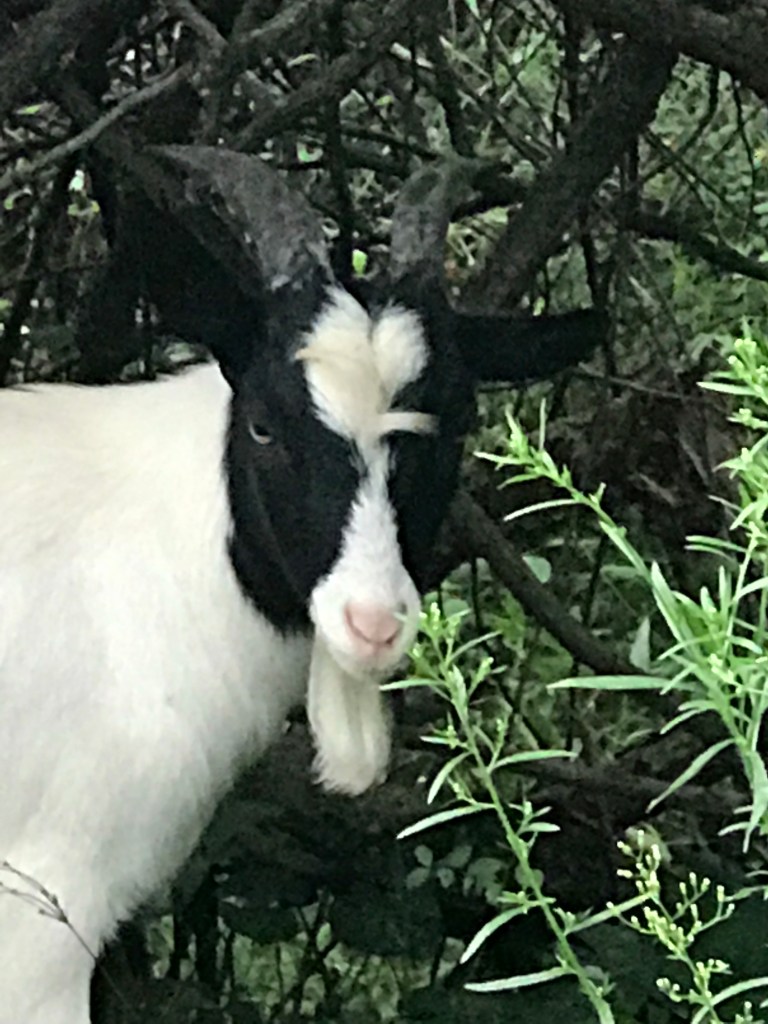
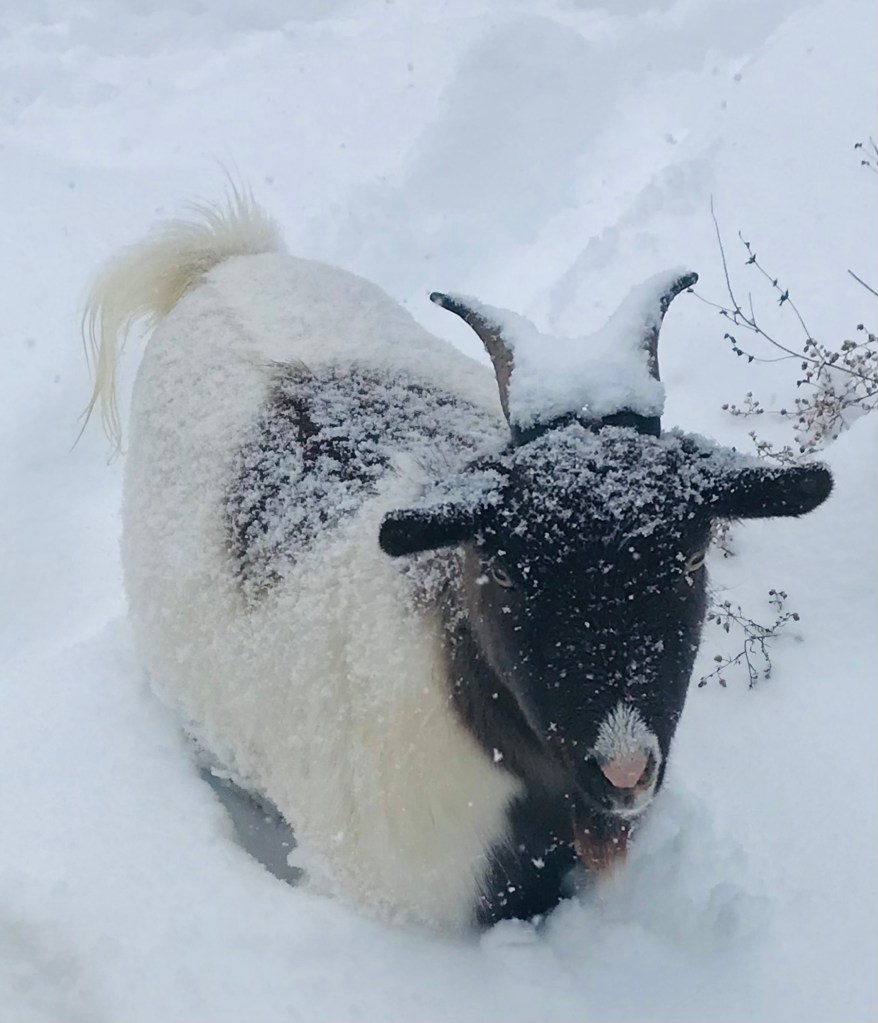
“Well, Come with me,” she rasped. And so we opened the gate and headed towards the barn. Inside were two small creatures in a bed of straw in a small holding bin. One was black and white and one was brown. The stared at us and then cowered in the corner of the pen. The brown one immediately stuck his front legs straight over and fell over on his side. His eyes looked like he was either having a seizure or was dead.
“I’ll take them,” I said.
“Where’s your trailer,” the goat lady asked.
“Oh, I don’t have one,” I suddenly realized.
“Well, it’s your car,” she shrugged. “You’re lucky that I neutered them. The big males like to urinate on their beards to attract females,” she declared. I winced, then I followed her through the gate and began to fold down the back seats in the Cruiser, looking feverishly for something to cover the back with and luckily found an old picnic blanket.
“Come on up to the house,” she commanded. So we did. The whole time Nancy was following us, a half smile on her face, eyes wide open, and a disbelieving sort of gaze. We walked into a small back door and stood in a strange little kitchen, mostly counter space with a burnt out looking toaster. There was a coffee can next to a big stack of papers. I wrote her a check. She handed me about 30 pages of hand written notes.
“This here is their feeding instructions,” she said. “I start with goat feed in the morning, not Purina, mind you, but the better stuff at Tractor Supply. Then I give them two scoops of real oats at around noon, then a lot of alfalfa in the evening. I just wormed them, but you’ll need to do that. It’s all in there.”
I looked at this overwhelming stack of barely legible pages and felt like crying. She then grilled me about having an adequate shelter for them. “Oh we just built a nice pole barn,” I lied. She had me sign a bunch of papers that would allow some goat organization to send me their pedigree (that, four years later, I’m still waiting for), shoved the instructions and a Folgers can full of oats in my hand and we headed back to the barn. We went inside, and the goat lady barked, “I’ll grab the black one, you grab the brown one.”
She jumped in the pen and goat legs went every which way. In what I can only describe as a goat rodeo hold, she hoisted the black spotted goat up to her chest half ran to the Toyota and threw it in the back. By that time I had been kicked, horn, bit and gouged. Nancy was laughing so hard she was no use. Somehow, the small goat and I stumbled to the SUV and I threw it in the back. Then the bleating began. I brushed hundreds of perfectly round little goat turds off of my arms, pants and shoes.
In a daze, I ordered Nancy into the FJ and tried to drive away. As we were leaving, the goat lady yelled, “Look out, those Arabs will want to steal them and eat them. They come down here all the time!” First of all, I doubted that anyone of Middle Eastern descent in their right mind would drive down her road, and second of all, I hadn’t seen too many bands of goat seeking raiders in the Blue Ridge so I waved and we got the hell out of there.
We both looked at our precious cargo in the back of the SUV and giggled. The goats were crying and complaining, but they fit, and we might just make it home with them. After about 10 minutes of incessant bleating I had an idea. One thing about FJ Cruisers is they have great rear speakers. I turned on the voice of the Blue Ridge, WPAQ AM and cranked up the old time and blue grass music they were playing. The goat boys quieted immediately! Especially to old time fiddle tunes. A revelation!
After three hours of radio, a stop at a convenient Tractor Supply Store off of Interstate 77 to buy a list of goat supplies and absolutely no “Love Language” talk, we made it home. Not wanting to hold these animals any more than I had to, I opened the gate to the two acre enclosure, backed in and wrangled each goat out the back and on to the ground. Brownie fainted again. Blackie stared at me like he might eat me. Then they wandered away.
I took the expensive feeding pan I had bought, filled it with some sugary smelling goat crack of some sort and watched them devour it like addicts. That was it. I was a bonafide goat farmer. I spent an hour cleaning goat turds out of the Toyota. That evening I read and reread the goat lady’s 30 pages of notes. About every two hours the next day I was running down to their pen. Oats, the goat crack (the expensive kind), then alfalfa, then more goat crack. A goat block in the pole shelter to lick on, and so on.
For the next three weeks I sat back and waited for the horrible brush in the goat area to disappear. Nothing happened.
“They’re crack goats,” I told Nancy in frustration. “I thought they were going to clear my land for me, make a nice area in there!” I complained, “They just sit around and wait for me to give them goat crack. I’ve become a pusher man!
Nancy had that look she gets when she doesn’t want to hurt my feelings. “Well,” she said, “What I’ve noticed is that they seem to be eating better than we do. If you’re down there feeding them on that ridiculous schedule, they don’t have time to eat brush.”
Damn, I hate it when I’m caught being so stupid. The next day, I stopped feeding them all together. Oh, they complained, yelling and bleating every time I even looked towards their lair. But slowly, gradually, I noticed that all of the Poison Ivy was disappearing from around the edges of the fence. Then the gawdawful briar bushes were gone. Then it happened, I saw Blackie tearing down an entire blackberry bush and ingesting it! Bowels of steel and all of it coming back to the land as a perfectly round, compact little turd ball.
I found one other real benefit to becoming a goat farmer. We suddenly had two live-in entertainment units for our resident rescue Corgi, Riley. Once he discovered the panels in the goat fence were just right for him to climb through he would head down in the morning and bark at the new residents. Then he would try to engage them in his favorite chase game that he plays with every other dog who visits, crocodile chase. Immediately Brownie fainted and Riley yelped, thinking he had killed him. Bigger brother Blackie walked over and applied both horns to the little brown dog’s stomach and I watched him fly through the air for about three feet. Entertainment at its best. Goat farming.
OK. I’ve never done this or ever thought I would do this. However, the last five years of my life since fleeing academia in a hurry and moving to a 3 room cabin in the heart of the Blue Ridge Mountains has been nothing short of unbelievable. Five years ago I drove down the mountain road on the left and have never looked back. As I’m sure you’ve heard, it took me 61 years to get here but it sure is worth it.
My journey started way out on the Kansas plains. In fact until my 50th year, I had never lived anywhere else. But with a family to help care for and mostly being self-employed, I took my PhD and headed to academia to see if I could grab some retirement. ” Nothing could be that bad,” I thought, “I can put up with it for a few years while my retirement account gets big and fat.” Little did I know.
I landed at a state university in New England, and did what I thought you were supposed to do. To engage. I helped pass anti-bullying laws, wrote papers and books and pamphlets and educated prisoners and parents and legislators. I responded to school shootings and taught teachers how to deal with angry and violent students. Basically, I got shit done. At the same time I had a lot of fun and created a lot of passion in my students. One thing they forget to tell you about the residents of the snooty ivory tower, though, is that they are a jealous, conniving, egocentric bunch who don’t like it when you get attention outside the hallowed halls.
So in 2016, I ran as fast as I could. High-tailed it for the mountains just as many before me had done.
In reality, it really was coming home. See, for the past 40 years I had been traveling to the Appalachians to fill my ears and my soul with pure mountain music. Since first hearing Old Time music at the Winfield Festival in the early 1970’s I have been deeply in love with it and pursued it where ever and whenever I could find it. It has become such a part of me that it seems to have infiltrated my very DNA.
First it was the Galax Fiddler’s Convention. I just had to go, but instead of feeding my lust for old time, it just created more need. As a social scientist and educator in my day jobs became more unforgiving and intense ( I was studying student violence and incivility) and the school shootings across the nation increased, I found a deep need to find a simpler, prettier, less complicated and certainly less depressing place to retreat. The year after Galax, I headed to the Mt. Airy Fiddler’s convention and was regaled with the music and incredible tales of the likes of Tommy Jarrell and Kyle Creed. The next year included The Elk Creek Festival in Virginia that was highly recommended to me by my dear friend, Frank Lee of The Freighthoppers fame (another blog) and so on. I was spending my entire summers camping and listening to and playing some of the best music on the planet.
So, many years later, here I sit on my cabin’s porch. Heading down a new hiking trail with my banjo over my shoulder. Coming across the mountain to share my life with you. Along the way, you’ll meet many of my friends, acquaintances and be exposed to some places you’ve probably never been. Our journey starts down here, in the holler, on the crick bank. You all comin’?
In the upcoming weeks we’ll explore:
Goat Raising
The Mystery of the Myers Brothers, Sidna and Fulton
The Wild Goose
The Boyd Family and Nearly 50 years of Moonshine and Mountain Music
Riley the Rescue Dog
The White Top Mountain Folk Festivals and how Whisnant got it wrong








 A Voice from the Holler: Dispatches from The Blue Ridge